GEO vs AEO: Key Differences Explained (2026 Decision Framework)


Ad Slot: leaderboard
Isi NEXT_PUBLIC_ADSENSE_CLIENT & AD_SLOTS

📌 Key Takeaways
- GEO and AEO share approximately 90% of their content tactics (Contently, 2026) — but the SERP features they target, featured snippets and AI Overviews, coexist on only about 7.42% of queries (SERPs.io, 2026). These are two different kinds of overlap, and confusing them leads to misallocated effort.
- When Google shows an AI Overview for a query, it typically does not also show a featured snippet — Google is making a binary choice per query, not layering both formats.
- AI Overview coverage grew from 31% to 48% of tracked queries between February 2025 and February 2026 (BrightEdge) — a keyword that rewarded AEO a year ago may reward GEO today.
- Industry coverage of AI Overviews varies sharply: healthcare queries trigger them at 88%, education at 83%, and B2B technology at 82% — meaning your industry alone is a strong signal for where to prioritize.
- The practical fix is a per-keyword check, not a company-wide strategy choice: search your target keyword, see what Google currently serves, and apply the matching playbook.
Ad Slot: in-feed
Isi NEXT_PUBLIC_ADSENSE_CLIENT & AD_SLOTS
📋 Table of Contents
- What’s Actually Different Between GEO and AEO~ 3 min
- The Data: Two Kinds of Overlap That Get Confused~ 3 min
- The 4-Step Per-Keyword Decision Framework~ 3 min
- GEO vs AEO Side-by-Side~ 2 min
- Three Scenarios: The Framework in Practice~ 3 min
- Tool: Which Playbook Should You Use?~ 2 min
- Frequently Asked Questions~ 2 min
- Conclusion~ 1 min
What’s Actually Different Between GEO and AEO
If you’ve read our guides on GEO and AEO, the short version is familiar: AEO targets becoming the direct answer — a featured snippet, a voice search result, a People Also Ask entry — typically with one source cited. GEO targets being one of several sources an AI weaves into a longer synthesized answer, like a Google AI Overview or a ChatGPT response.
That distinction is correct, but it leaves out the part that actually changes what you should do on a Tuesday morning when you’re deciding which page to optimize next. Here it is: the content structure that wins each overlaps by roughly 90%, but the SERP feature each appears in is largely mutually exclusive, query by query. A page that’s perfectly structured for both AEO and GEO can still only “win” one of them for any given search — because Google typically shows either a featured snippet or an AI Overview for a query, not both.
This matters because most “AI SEO checklists” — including the ones in our own AI SEO Guide and AEO Guide — describe content-level changes that serve both disciplines simultaneously. That’s accurate and still the right starting point. But once those changes are made, the question of which result you should expect, and where to look for it, depends on something the content itself doesn’t control: what Google is currently serving for that specific keyword.
💬 According to EverydayOnAI
This is the single most common reporting mistake we see in AI SEO reviews: teams do the right structural work, then check the wrong dashboard for results. If Google is serving an AI Overview for a keyword, checking Search Console for a new featured snippet will show nothing — even if GEO citation rate for that exact page is climbing in ChatGPT and Perplexity. The fix isn’t more work. It’s running the 30-second check in Step 1 of the framework below before deciding where to look for the win, and before concluding the work “didn’t work.”
📋 Section Summary
- AEO and GEO target different SERP features (single-source snippet vs. multi-source AI synthesis) but are built using largely the same content structure — direct answers, clear headings, self-contained statistics.
- Because Google typically serves either a featured snippet or an AI Overview for a given query — not both — the same well-structured content can only “win” one of these surfaces per keyword.
- This means measurement and expectations need to be set per keyword, based on which SERP feature Google currently shows, not applied uniformly across a content backlog.
The Data: Two Kinds of Overlap That Get Confused
There are two genuinely different statistics floating around AI SEO content in 2026, and they get conflated constantly because they both involve the word “overlap.”
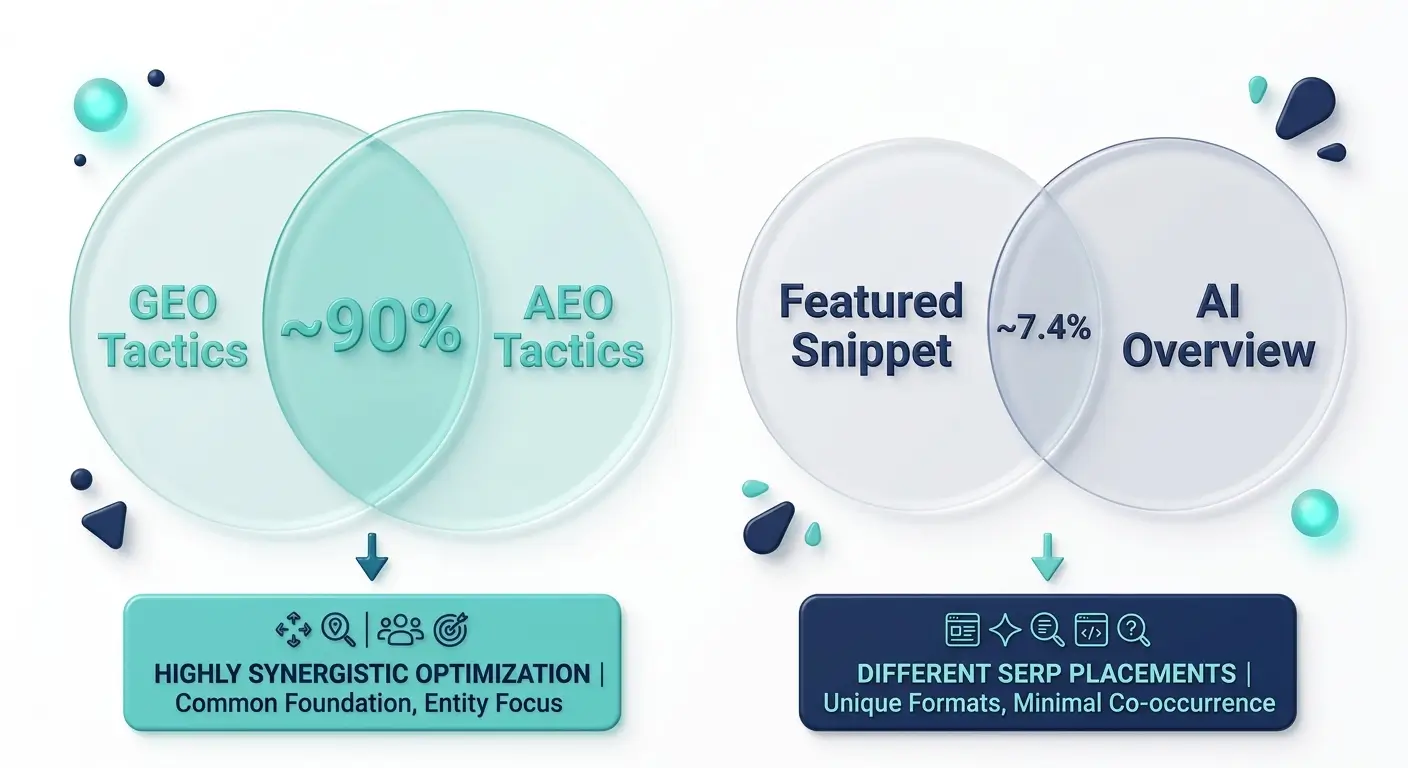
The first statistic — tactical overlap — is high. The content patterns that win featured snippets (direct first-sentence answers, clear question-format headings, properly structured lists and tables) are largely the same patterns that earn AI Overview citations.[a] Optimizing for featured snippet capture has been described as “the highest-leverage path to AI Overview citation, not a competing strategy.”[a]
The second statistic — SERP feature co-occurrence — is low. Analysis from SERPs.io found that featured snippets and AI Overviews coexist on only about 7.42% of queries.[b] When an AI Overview appears, Google typically does not also show a featured snippet for that query — it’s a binary choice, not a stacking of features.[b] A separate SE Ranking study of AI Mode versus AI Overview — two different Google AI surfaces — found similarly low co-occurrence: 10.7% URL overlap and 16% domain overlap.[c]
~90%
overlap in content tactics between GEO and AEO — same structural patterns serve both[shared]
~7.4%
of queries show both a featured snippet and an AI Overview at the same time[b]
31% → 48%
growth in AI Overview query coverage, Feb 2025 to Feb 2026 (BrightEdge tracking)[c]
88% / 82%
of healthcare / B2B technology queries trigger an AI Overview — sharp industry variance[c]
13.7%
citation overlap between Google AI Overviews and Google AI Mode — two distinct surfaces[d]
-37.04%
CTR decline on queries where an AI Overview overlaps with a former featured snippet position[e]
A First-Party Data Point Worth Noting
One practitioner team tracking their own AI citation performance since mid-2025 found that FAQ sections — specifically, blocks with 40-60 word self-contained answer openers — were cited in AI-generated answers at roughly 3 times the rate of non-FAQ content sections on the same site.[d] They also found that posts with one hyperlinked statistic per 150-200 words consistently outperformed lower-density posts in AI citation frequency.[d] This is a useful real-world confirmation of the “90% tactical overlap” claim — the same FAQ structure that’s a textbook AEO move (targeting People Also Ask) is what produced their 3x GEO citation lift.
📋 Section Summary
- “GEO and AEO overlap ~90%” refers to content tactics (structure, formatting, schema). “Featured snippets and AI Overviews overlap ~7.4%” refers to which SERP feature appears for a given query. These are different measurements and both are true simultaneously.
- AI Overview coverage nearly doubled in one year (31% → 48%, BrightEdge), with sharp industry variance — healthcare and education sites should expect AI Overview dominance more than e-commerce sites currently do.
- A practitioner case found FAQ-formatted content (a core AEO tactic) earned roughly 3x more AI citations (a GEO outcome) than non-FAQ content on the same site — direct evidence of the tactical overlap in action.
The 4-Step Per-Keyword Decision Framework
This framework replaces “should we focus on GEO or AEO?” — a question with no single correct answer — with a per-keyword check that takes about 30 seconds per query.
✓ The 4-Step Framework
- Step 1 — Check what Google currently serves. Search your target keyword (ideally in an incognito window, on both desktop and mobile). Note whether a featured snippet, an AI Overview, both, or neither appears above the organic results.
- Step 2 — If a featured snippet appears: apply the AEO playbook from our AEO Guide — a 40-60 word direct-answer paragraph, FAQPage/HowTo schema, and the Snippet-Readiness Checker tool. Track success via Search Console snippet appearance.
- Step 3 — If an AI Overview appears: apply the GEO playbook from our GEO Guide — self-contained statistics with inline source attribution, Section Summary boxes, and content depth above 20,000 characters. Track success via manual citation testing and AI referral sessions in GA4.
- Step 4 — If neither appears and you’re not on page one: neither AEO nor GEO formatting will move this keyword yet. Prioritize traditional SEO — backlinks, on-page fundamentals, content depth — then re-run Step 1 once you reach page one.
- Revisit quarterly. With AI Overview coverage nearly doubling in a year, a keyword’s classification can change. Build this check into your existing quarterly content refresh cycle rather than treating it as a one-time audit.
One nuance worth flagging: Step 2 and Step 3 are not mutually exclusive at the content level — you should still make GEO-friendly structural changes even on a page targeting a featured snippet, because (a) the tactical overlap means this costs little extra effort, and (b) that same keyword’s classification may shift to AI Overview within months, per the 31% → 48% trend. The framework determines where you look for results and what you measure, not which structural changes you make.
📋 Section Summary
- The 4-step framework is: check what Google currently serves for the keyword, then apply the AEO playbook (if snippet), GEO playbook (if AI Overview), or SEO-first (if neither and not page one) — revisited quarterly.
- This framework governs measurement and prioritization, not content structure — make GEO-friendly changes even on AEO-targeted pages, since the tactical overlap is high and keyword classifications shift over time.
- The 30-second per-keyword check replaces an unanswerable strategic question (“GEO or AEO?”) with an operational one (“what does Google show right now, for this specific query?”).
GEO vs AEO Side-by-Side
A condensed, decision-focused comparison — see the full AI SEO Guide comparison table for the complete GEO/AEO/LLMO breakdown including LLMO.
| Dimension | AEO | GEO |
|---|---|---|
| SERP feature targeted | Featured snippet, PAA, voice answer | AI Overview, ChatGPT/Perplexity citation |
| Source pattern | Single source, verbatim passage extracted | Multiple sources, synthesized and paraphrased |
| Ideal content unit | One 40-60 word answer per heading | Multiple question-specific sections per page |
| Where to check results | Search Console (snippet/PAA appearance) | Manual prompt testing + GA4 AI referral filter |
| Per-query co-occurrence | ~7.4% — largely mutually exclusive per query[b] | |
| Content tactic overlap | ~90% — same structural changes serve both[shared] | |
📋 Section Summary
- AEO and GEO differ primarily in source pattern (single verbatim source vs. multi-source synthesis) and ideal content unit (one tight answer vs. multiple question-specific sections).
- Despite targeting different SERP features that rarely co-occur (~7.4%), the underlying content tactics overlap by ~90% — write for GEO’s multi-section depth, and AEO eligibility largely follows.
Three Scenarios: The Framework in Practice
Here’s how the 4-step framework plays out across three realistic situations — illustrating why “GEO vs AEO” is the wrong question to ask about a whole site, but the right question to ask about a specific keyword.
Scenario A — “Before” Mindset
A B2B SaaS content team applies the same AEO checklist (40-60 word direct answers, FAQPage schema) uniformly across their entire blog, then checks Search Console for snippet wins three months later. For their highest-traffic informational pages — in a vertical where 82% of queries now trigger an AI Overview — almost no new snippets appear, despite the formatting being textbook-correct.
Ad Slot: rectangle
Isi NEXT_PUBLIC_ADSENSE_CLIENT & AD_SLOTS
Scenario A — “After” Framework
The same team runs Step 1 on those keywords and finds AI Overviews, not snippets, are what Google now serves for B2B technology queries at an 82% rate. They keep the same content structure (it’s ~90% the same work) but switch their measurement to manual AI citation testing and GA4 AI referral sessions — and immediately see the citations they’d been producing all along, just in the wrong dashboard.
Scenario B — Local Service Query
A local business optimizes its “emergency plumber [city]” page with GEO-style long-form content — 2,000+ words, multiple data sections, Section Summary boxes — expecting AI Overview citation.
Scenario B — Framework-Correct Approach
Step 1 reveals this query still shows a classic featured snippet with local pack results — a query type where AI Overviews remain less dominant. The AEO playbook (a tight, 40-60 word direct answer about emergency availability and hours, with Speakable schema) is the higher-leverage move here, not additional GEO-style depth the format won’t surface.
Scenario C — New Content, Unranked
A team publishes a new pillar article and immediately applies the full AEO + GEO checklist, expecting snippet or citation wins within weeks.
Scenario C — Framework-Correct Approach
Step 1 shows the page isn’t on page one yet for its target keyword — Step 4 applies. Neither AEO nor GEO formatting can produce results until the page earns enough ranking authority to be considered for snippet or citation eligibility at all. The team focuses on backlinks and topical authority first, with AEO/GEO structure already in place (so no rework is needed later) but expectations correctly set to “after page one,” not “within weeks.”
📋 Section Summary
- The same content structure can produce a featured snippet, an AI Overview citation, or neither, depending entirely on what Google currently serves for that specific query — not on how well the content is written.
- Measurement misalignment (checking for snippets when Google now serves AI Overviews for that query type) can make successful GEO work look like a failure.
- For unranked pages, AEO and GEO formatting is still worth doing upfront (it’s largely the same work either way) — but results should be expected only after the page reaches page one.
Tool: Which Playbook Should You Use?
Run Step 1 of the framework right now for one of your target keywords, then use this tool to get the matching next step.
🎯 Interactive Tool
GEO vs AEO Playbook Router
Search your target keyword in an incognito window first. Then answer the question below based on what you see at the top of the results page.
What appears at the top of Google for your target keyword?
This tool provides directional guidance based on the per-keyword framework above. SERP features change over time — re-run this check quarterly, especially for keywords in industries with high AI Overview coverage (healthcare, education, B2B technology).
Frequently Asked Questions
What is the main difference between GEO and AEO?
AEO targets becoming a single, directly-extracted answer; GEO targets being one of several sources synthesized into a longer AI-generated response. AEO (Answer Engine Optimization) wins featured snippets, voice search results, and People Also Ask entries — typically citing one source verbatim. GEO (Generative Engine Optimization) wins citations inside AI Overviews, ChatGPT responses, and Perplexity answers, where content from multiple sources is paraphrased and combined. The content structure that wins each overlaps by roughly 90%, but the SERP feature each appears in is largely mutually exclusive on a per-query basis.
Can a page have both a featured snippet and be cited in an AI Overview?
Rarely for the same query — research found featured snippets and AI Overviews coexist on only about 7.42% of queries.[b] When Google shows an AI Overview, it typically does not also show a featured snippet for that query — it’s a binary choice per query. However, a single page can hold a featured snippet for one query and be cited inside an AI Overview for a different, related query, since both formats draw on the same underlying content quality and structure.
Which should I prioritize first, GEO or AEO?
Check what Google currently serves for your target keyword, then apply the matching playbook. If a featured snippet appears, prioritize AEO formatting. If an AI Overview appears, prioritize GEO formatting. If neither appears and you’re not on page one, prioritize traditional SEO first. This per-keyword check matters more than choosing one discipline as a company-wide strategy.
How often should I re-check which SERP feature my keywords trigger?
Quarterly, at minimum — more often in high-AI-Overview-coverage industries. BrightEdge’s tracking found AI Overview coverage grew from 31% to 48% of queries between February 2025 and February 2026.[c] Healthcare (88%), education (83%), and B2B technology (82%) queries trigger AI Overviews at especially high rates[c] — sites in these verticals should check more frequently than the quarterly baseline.
Do GEO and AEO require different content, or the same content formatted differently?
The same underlying content, with different framing of the answer. AEO favors one tight 40-60 word answer immediately after a heading, optimized to stand alone as a single extracted passage. GEO favors multiple question-specific sections, each with its own direct answer, self-contained statistics, and inline source attribution. Content structured well for GEO is usually AEO-eligible as a byproduct — but the reverse requires adding more sections, not just perfecting one paragraph.
Conclusion: Stop Choosing a Side
“GEO vs AEO” sounds like a strategic fork in the road — pick one, build a roadmap around it, report on it quarterly. The data suggests that framing is the mistake. The content tactics overlap by roughly 90%, so the work itself is largely shared. What differs, and what genuinely requires a decision, is where you should expect to see the result of that work — and that’s determined per keyword, by what Google is currently serving, not by your overall content strategy.
The action item from this article is small but high-leverage: take your top 10-20 target keywords, run Step 1 of the framework on each (search them, note what appears), and sort them into three buckets — snippet-classified, AI-Overview-classified, and neither. That sort takes under an hour and tells you exactly where to look for results from the AEO and GEO work you’re already doing, or about to do, from the AEO Guide and GEO Guide.
💬 According to EverydayOnAI
If you only do one thing from this article, do the hour-long keyword sort before touching any content. Every checklist in the AI SEO Hub — the AEO checklist, the GEO checklist, the AI Citation Readiness Score — assumes you already know which bucket each target keyword falls into. Skipping this step is how “we did everything right but saw no results” reports happen: the content work was correct, but it was being measured against the wrong SERP feature for that keyword. The sort is boring. It’s also the cheapest insurance against a wasted quarter that we know of.
📚 References and Sources
- DigitalApplied, “Featured Snippets in the AI Overview Era: 2026 Guide,” March 2026. Strong correlation found between pages previously selected as featured snippets and pages cited as sources in AI Overviews; structured direct answers drive both snippet and AI Overview selection; optimizing for featured snippets described as the highest-leverage path to AI Overview citation. digitalapplied.com
- SERPs.io, “How to Win Featured Snippets in an AI Overview World,” March 2026. Featured snippets and AI Overviews coexist on approximately 7.42% of queries — Google makes a binary per-query choice between serving a snippet or an AI Overview, not both. serps.io
- Averi.ai, “How to Get Featured in Google AI Overviews (2026 Playbook),” citing BrightEdge tracking data, April 2026. AI Overview coverage grew from 31% to 48% of tracked queries, February 2025 to February 2026; industry variance — healthcare 88%, education 83%, B2B technology 82% of queries trigger AI Overviews; Google AI Mode reached 75 million daily users and over 1 billion monthly queries by late 2025. averi.ai
- Averi.ai, same source, first-party content library data. Only 13.7% citation overlap between AI Overviews and AI Mode; FAQ blocks with 40-60 word self-contained answers cited in AI-generated responses at approximately 3x the rate of non-FAQ content; statistics density of one hyperlinked stat per 150-200 words correlates with higher AI citation frequency. averi.ai
- Amsive, 700,000-keyword CTR study (2025), cited via The Digital Bloom, “2026 AI Citation Position & Revenue Report,” May 2026. Average CTR decline of 15.49% across the study; queries where an AI Overview overlapped with a former featured snippet position saw a steeper 37.04% CTR decline. thedigitalbloom.com
Sources verified June 14, 2026. SERP feature co-occurrence statistics vary by methodology (query sampling, geography, device) — figures here represent the most recent and methodologically transparent sources available. This article does not constitute professional SEO advice and does not guarantee snippet placement or AI citation outcomes.
📚 Go Deeper: Complete AI SEO Hub on EverydayOnAI
This article is part of the AI SEO Hub. Start with the pillar guide, then apply the playbook that matches what your target keywords are currently showing.
-
→ What is AI SEO? The Complete Guide to GEO, AEO & LLMO
The pillar guide — the full AI SEO stack, the Implementation Checklist, and the AI Citation Readiness Score tool. -
→ What is AEO? The Complete Answer Engine Optimization Guide
The AEO playbook referenced in Step 2 of this article’s framework — includes the Snippet-Readiness Checker tool. -
→ GEO Complete Guide: How to Get Cited by ChatGPT, Perplexity & Google AI
The GEO playbook referenced in Step 3 of this article’s framework — covers AI Overview and AI chat citation tactics in depth. -
→ AEO vs SEO: What Changes and What Stays
For Step 4 of this article’s framework — what to do when neither AEO nor GEO applies yet because the page isn’t on page one. -
→ AEO Keyword Research: Finding Answer-Intent Queries
A methodology for building the keyword list you’ll run through this article’s decision framework and router tool.
Sort Your Keywords in Under an Hour
Download our free Keyword SERP Classifier spreadsheet — log your top 20 target keywords, note what Google currently serves for each (snippet, AI Overview, or neither), and get an auto-generated priority list using the 4-step framework from this article.
Ad Slot: leaderboard-2
Isi NEXT_PUBLIC_ADSENSE_CLIENT & AD_SLOTS
Share this article